Destination Munich, Germany

When Germans are polled about where they would most like to live, Munich finds its way consistently to the top of the list. Being within easy driving distance of the Alps, Italy and the Mediterranean, the Czech Republic, Austria and some of the most beautiful scenery in Europe, it's not surprising everyone wants to be there!.
• Munich at a Glance A-Z
» Allianz Arena
The Allianz Arena is a football stadium in the north of Munich, Germany. The two professional Munich football clubs FC Bayern Munich and TSV 1860 Munchen have played their home games at Allianz Arena since the start of the 2005–06 season. Both clubs had previously played their home games at the Munich Olympic Stadium since 1972 …
» Alte Pinakothek Art Museum
The Alte Pinakothek (Old Pinakothek) is an art museum situated in the Kunstareal in Munich, Germany. It is one of the oldest and finest galleries in the world. The name aludes to the time period covered by the art - the Neue Pinakothek covers 19th century art and the Pinakothek der Moderne exhibits modern art …
» BMW Welt
The BMW Welt is a multi-functional customer experience and exhibition facility of the BMW AG, located in Munich, Germany. In direct proximity to the BMW Headquarters and the Olympiapark, it is designed to present the current products of BMW, be a distribution center for BMW cars, and offer an event forum and a conference center. BMW Welt also offers shops with BMW auxiliary products, as well as a fully serviced gastronomic restaurant …
» Englischer Garten
The Englischer Garten, German for 'English Garden', is a large public park in the centre of Munich, Bavaria, stretching from the city centre to the northeastern city limits. It was created in 1789 by Sir Benjamin Thompson (1753-1814), later Count Rumford (Reichsgraf von Rumford) and extended and improved by his successors, Reinhard von Werneck (1757-1842) and Friedrich Ludwig von Sckell (1750-1823), who had advised on the project from the beginning …
» Frauenkirche
The Frauenkirche (Cathedral of Our Dear Lady) is the cathedral of the Archbishop of Munich and Freising. It is a landmark and is considered a symbol of the Bavarian State Capital. The church towers are widely visible because of local height limits. The city administration prohibits buildings with a height exceeding 109 metres (358 ft) in the city center …
» Glyptothek Museum
The Glyptothek is a museum in Munich, Germany, which was commissioned by the Bavarian King Ludwig I to house his collection of Greek and Roman sculptures (hence Glypto-, from the Greek root glyphein, to carve). It was designed by Leo von Klenze in the Neoclassical style, and built from 1816 to 1830 …
» Hofbrauhaus
The Staatliches Hofbrauhaus in Munchen (state court-brewery in Munich, also Hofbrau Munchen) is a brewery in Munich, Germany, owned by the Bavarian state government. The Hof (court) comes from the brewery's history as a royal brewery in the Kingdom of Bavaria. The brewery owns the Hofbrauhaus am Platzl, the Hofbraukeller and the second largest tent at the Oktoberfest (Hofbrau-Festzelt) …
» Karlsplatz (Stachus)
Stachus is a large square in central Munich. The square has been named officially Karlsplatz in 1797 after the unpopular Karl Theodor, Elector of Bavaria. Munich natives seldom use that name, calling the square instead Stachus, after the pub Beim Stachus, once owned by Eustachius Föderl, that was located there until construction work for Karlsplatz began …
» Marienplatz
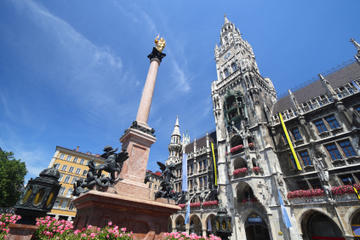
Marienplatz is a central square in the city center of Munich, since 1158. In the Middle Ages markets and tournaments were held in this city square. Marienplatz was named after the Mariensaule, a Marian column erected in its centre in 1638 to celebrate the end of Swedish occupation. Today the Marienplatz is dominated by the New City Hall (Neues Rathaus) …
» Munich Residenz
The Munich Residenz is the former royal palace of the Bavarian monarchs in the center of the city of Munich, Germany. The Residenz is the largest city palace in Germany and is today open to visitors for its architecture and room decorations, and displays from the former royal collections. The complex of buildings contains ten courtyards and the museum displays 130 rooms …
» National Theatre
The National Theatre Munich is an opera house in Max-Joseph-Platz, in Munich, Germany. It is the home of the Bavarian State Opera, and the Bavarian State Ballet (Bayerisches Staatsballett). During its early years, the National Theatre saw the premieres of a significant number of operas, including many by German composers. These included Wagner's Tristan und Isolde (1865); Die Meistersinger von Nurnberg (1868); Das Rheingold (1869); and Die Walkure (1870) …
» New Town Hall
The New Town Hall (German: Neues Rathaus) is a town hall at the northern part of Marienplatz in Munich, Bavaria, Germany. It hosts the city government including the city council, offices of the mayors and part of the administration. In 1874 the municipality had left the Old Town Hall for its new domicile …
» Nymphenburg Palace
The Nymphenburg Palace is a Baroque palace in Munich, Bavaria, Germany. The palace was the main summer residence of the rulers of Bavaria. The palace was commissioned by the prince-electoral couple Ferdinand Maria and Henriette Adelaide of Savoy to the designs of the Italian architect Agostino Barelli in 1664 after the birth of their son Maximilian II Emanuel …
» Oktoberfest
Each year, the Oktoberfest is attended by around 6 million visitors, who drink around 5 million liters of beer and consume over 200,000 pairs of pork sausages. At the foot of the Bavaria statue, the huge Oktoberfest grounds also provide carousels, roller coasters and all the spectacular fun of the fair …
» Olympic Stadium
Olympiastadion is a stadium located in Munich, Germany. Situated at the heart of the Olympiapark Munchen in northern Munich, the stadium was built as the main venue for the 1972 Summer Olympics. With an original capacity of 80,000, the stadium also hosted many major football matches including the 1974 World Cup Final and the Euro '88 Final. It hosted the European Cup Finals of 1979, 1993 and 1997 …
» Rathaus Glockenspiel
The Rathaus Glockenspiel of Munich is a tourist attraction in Marienplatz the heart of Munich. Part of the second construction phase of the New Town Hall, it dates from 1908. Every day at 11 a.m. (as well as 12 p.m. and 5 p.m. in summer) it chimes and re-enacts two stories from the 16th century to the amusement of mass crowds of tourists and locals. It consists of 43 bells and 32 life-sized figures …
» Schleissheim Palace
The Schleissheim Palace actually comprises three palaces in a grand baroque park in the village of Oberschleißheim near Munich. The palace was the summer residence of the rulers of Bavaria. The history of Schleissheim Palace started with a renaissance country house (1598) and hermitage founded by William V close to Dachau Palace …
» Viktualienmarkt
The Viktualienmarkt is a daily food market and a square in the center of Munich. The Viktualienmarkt developed from an original farmers' market to a popular market for gourmets. In an area covering 22,000 m2 (240,000 sq ft), 140 stalls and shops offer flowers, exotic fruit, game, poultry, spices, cheese, fish, juices and so on. Most stalls and shops are open during the official opening hours (Monday to Saturday 8 a.m. until 8 p.m.); but the Biergarten doesn't open until 9 a.m. …