HOME •
THE NETHERLANDS •
OF INTEREST •
Amsterdam •
Anne Franke House
ANNE FRANK HOUSE
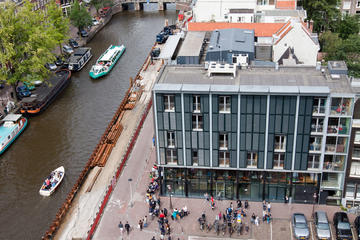
The Anne Frank House at the Prinsengracht in Amsterdam, The Netherlands, is a museum, housed partly in the building where the Frank family went into hiding in July 1942, in hidden rooms in Anne's father Otto Frank's office: The Annexe.
It opened on May 3, 1960. It consists of the Opekta warehouse and offices and the achterhuis, all unfurnished so that visitors can walk freely through the rooms. Some personal relics of the former occupants remain, such as movie star photographs glued by Anne to a wall, a section of wallpaper on which Otto Frank marked the height of his growing daughters, and a map on the wall where he recorded the advance of the Allied Forces, all now protected behind Perspex sheets.
From the small room which was once home to Peter van Pels, a walkway connects the building to its neighbours, also purchased by the Foundation. These other buildings are used to house the diary, as well as changing exhibits that chronicle different aspects of the Holocaust and more contemporary examinations of racial intolerance in various parts of the world. It has become one of Amsterdam's main tourist attractions, and is visited by more than half a million people each year.
ANNE FRANK
Annelies Marie "Anne" Frank (June 12, 1929 - c. March 1945) was a German Jewish girl who wrote a diary while in hiding with her family and four friends in Amsterdam during the German occupation of the Netherlands in World War II. Her family had moved to Amsterdam after the Nazis gained power in Germany but were trapped when the Nazi occupation extended into The Netherlands.
As persecutions against the Jewish population increased, the family went into hiding in July 1942 in hidden rooms in Otto Frank's office building. After two years in hiding, the group was betrayed and transported to the concentration camp system where Anne died of typhus (in Bergen-Belsen) within days of her sister, Margot, in February or March 1945. Her father, Otto, the only survivor of the group, returned to Amsterdam after the war ended, to find that her diary had been saved. Convinced that it was a unique record he took action to have it published.
The diary was given to Anne Frank for her thirteenth birthday and chronicles the events of her life from June 12, 1942 until its final entry of August 1, 1944. It was eventually translated from its original Dutch into many languages and became one of the world's most widely read books. There have also been many theatrical productions, and an opera, based on the diary. Described as the work of a mature and insightful mind, it provides an intimate examination of daily life under Nazi occupation; through her writing, Anne Frank has become one of the most renowned and discussed of the Holocaust victims.
THE ANNEXE
The Annexe was the original title of the diary of Anne Frank. It was the name of the house in which she and her family hid during the Second World War.
This was the original English title. The Dutch title of the book based on her diary, and the name of the house where they were in hiding, is "Het Achterhuis", literally meaning "the backhouse", or "annex" of the house.
LIFE IN THE ACHTERHUIS
On July 5, 1942, the family moved into the hiding place. Their apartment was left in a state of disarray to create the impression that they had left suddenly, and Otto Frank left a note that hinted they were going to Switzerland. As Jews were not allowed to use public transport they walked several kilometres from their home, with each of them wearing several layers of clothing as they did not dare to be seen carrying luggage.
The achterhuis (a Dutch word denoting the rear part of a house) was a three-story space at the rear of the building that was entered from a landing above the Opekta offices. Two small rooms, with an adjoining bathroom and toilet, were on the first level, and above that a large open room, with a small room beside it. From this smaller room, a ladder led to the attic. The door to the achterhuis was later covered by a bookcase to ensure it remained undiscovered. Anne would later refer to it in her diary as the "Secret Annexe". The main building, situated a block from the Westerkerk, was nondescript, old and typical of buildings in the western quarters of Amsterdam.
Victor Kugler, Johannes Kleiman, Miep Gies, and Bep Voskuijl were the only employees who knew of the people in hiding, and with Gies' husband Jan Gies and Voskuijl's father Johannes Hendrik Voskuijl, were their "helpers" for the duration of their confinement. They provided the only contact between the outside world and the occupants of the house, and they kept them informed of war news and political developments. They catered for all of their needs, ensured their safety and supplied them with food, a task that grew more difficult with the passage of time. Anne wrote of their dedication and of their efforts to boost morale within the household during the most dangerous of times. All were aware that if caught they could face the death penalty for sheltering Jews.
In late July, the Franks were joined by the van Pels family: Hermann, Auguste, and 16-year-old Peter, and then in November by Fritz Pfeffer, a dentist and friend of the family. Anne wrote of her pleasure at having new people to talk to, but tensions quickly developed within the group forced to live in such confined conditions.
After sharing her room with Pfeffer, she found him to be insufferable, and she clashed with Auguste van Pels, whom she regarded as foolish. Her relationship with her mother was strained, and Anne wrote that they had little in common as her mother was too remote. Although she sometimes argued with Margot, she wrote of an unexpected bond that had developed between them, but she remained closest emotionally to her father. Some time later, after first dismissing the shy and awkward Peter van Pels, she recognised a kinship with him and the two entered a romance.
Anne spent most of her time reading and studying, while continuing to write and edit her diary. In addition to providing a narrative of events as they occurred, she also wrote about her feelings, beliefs and ambitions, subjects she felt she could not discuss with anyone. As her confidence in her writing grew, and as she began to mature, she wrote of more abstract subjects such as her belief in God, and how she defined human nature. She continued writing regularly until her final entry of August 1, 1944.
On the morning of August 4, 1944, the achterhuis was stormed by the Grüne Polizei following a tip-off from an informer who was never identified. Led by Schutzstaffel Oberscharführer Karl Silberbauer of the Sicherheitsdienst, the group included at least three members of the Security Police. The occupants were loaded into trucks and taken for interrogation. Victor Kugler and Johannes Kleiman were taken away and subsequently jailed, but Miep Gies and Bep Voskuijl were allowed to go. They later returned to the achterhuis, where they found Anne's papers strewn on the floor. They collected them, as well as several family photograph albums, and Gies resolved to return them to Anne after the war.
On May 3, 1957, a group of citizens including Otto Frank established the Anne Frank Foundation in an effort to save the Prinsengracht building from demolition and to make it accessible to the public. Otto Frank insisted that the aim of the foundation would be to foster contact and communication between young people of different cultures, religions or racial backgrounds, and to oppose intolerance and racial discrimination.
The Anne Frank House opened on May 3, 1960. It consists of the Opekta warehouse and offices and the achterhuis, all unfurnished so that visitors can walk freely through the rooms. Some personal relics of the former occupants remain, such as movie star photographs glued by Anne to a wall, a section of wallpaper on which Otto Frank marked the height of his growing daughters, and a map on the wall where he recorded the advance of the Allied Forces, all now protected behind Perspex sheets.
From the small room which was once home to Peter van Pels, a walkway connects the building to its neighbours, also purchased by the Foundation. These other buildings are used to house the diary, as well as changing exhibits that chronicle different aspects of the Holocaust and more contemporary examinations of racial intolerance in various parts of the world. It has become one of Amsterdam's main tourist attractions, and is visited by more than half a million people each year.
In 1963, Otto Frank and his second wife Elfriede Geiringer-Markovits set up the Anne Frank Fonds as a charitable foundation, based in Basel, Switzerland. The Fonds raises money to donate to causes "as it sees fit". Upon his death, Otto willed the diary's copyright to the Fonds, on the proviso that the first 80,000 Swiss francs in income each year was to be distributed to his heirs, and any income above this figure was to be retained by the Fonds to use for whatever projects its administrators considered worthy.
It provides funding for the medical treatment of the Righteous Among the Nations on a yearly basis. It has aimed to educate young people against racism and has loaned some of Anne Frank's papers to the United States Holocaust Memorial Museum in Washington, D.C. for an exhibition in 2003. Its annual report of the same year gave some indication of its effort to contribute on a global level, with its support of projects in Germany, Israel, India, Switzerland, the United Kingdom and the United States
From Wikipedia
HOTELS AND ACCOMMODATION IN AMSTERDAM
TOURS & TRAVEL IN THE NETHERLANDS
HOME •
THE NETHERLANDS •
OF INTEREST •
Amsterdam •
Anne Franke House
|
|
Looking for something specific?
|
QUICK LINKS FOR THE NETHERLANDS:
|
NETHERLANDS HOTELS:
NORTH HOLLAND HOTELS:
Alkmaar,
AMSTERDAM,
Badhoevedorp,
Haarlem,
Hilversum,
Hoofddorp,
IJmuiden,
Loosdrecht,
Schiphol,
Uithoorn,
Volendam,
Zaandam,
Zandvoort,
|
NETHERLANDS TOURS:
AMSTERDAM TOURS & TRAVEL:
Attractions,
City Passes,
Cycling Tours,
Day Tours,
Dinner Tours,
Night Cruises,
Shows,
Sightseeing Tours,
Sightseeing Cruises,
Transfers,
Walking Tours,
... see all Netherlands Tours
|
DISCOVER THE NETHERLANDS:
NORTH HOLLAND:
AMSTERDAM:
Anne Frank House,
History of Amsterdam,
Museums of Amsterdam,
De Wallen (Red Light District),
SAIL Amsterdam,
... see all Amsterdam
|

|