Destination Bavaria, Germany

Bavarians commonly emphasize pride in their traditions. Traditional costumes are worn on special occasions, century-old folk music is practised and dialect songs and poems are taught in nursery schools. The May Poles, and the bagpipes in the Upper Palatinate region bear witness to the ancient Celtic and Germanic remnants of cultural heritage of the region.
• Most Popular Destinations in Bavaria
» Destination Munich
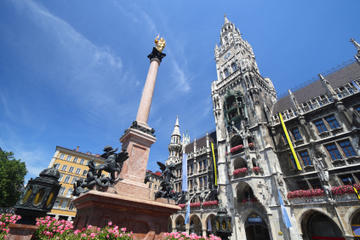
When Germans are polled about where they would most like to live, Munich finds its way consistently to the top of the list. Being within easy driving distance of the Alps, Italy and the Mediterranean, the Czech Republic, Austria and some of the most beautiful scenery in Europe, it's not surprising everyone wants to be there! …
… see all Destination Munich, Bavaria
• Bavaria at-a-glance A-Z
» Discover Augsburg
Augsburg was founded in 15 BC in the reign of Roman emperor Augustus as a garrison called Augusta Vindelicorum. It was laid to waste by the Huns in the fifth century, by Charlemagne in the eighth, and by Welf of Bavaria in the eleventh; it rose each time only to greater prosperity. It became an Imperial Free City in 1276…
» Discover Bamberg
The Old Town of Bamberg is included in the UNESCO World Heritage, since it has retained its medieval look and was one of the few German cities that sustained virtually no damage during WWII. The cathedral is a late Romanesque building with four imposing towers. It was founded in 1004 by the emperor Henry II …
» Discover Bayreuth
Bayreuth is a sizeable town in northern Bavaria, on the Red Main river in a valley between the Franconian Jura and the Fichtelgebirge Mountains. The town's roots date back to 1194. It is world-famous for its annual Bayreuth Festival at which performances of operas by the 19th century German composer Richard Wagner are presented …
» Discover Burghausen
Burghausen is the largest city in the Altötting district of Oberbayern in Germany. It is situated on the Salzach river, near the border with Austria. Its castle, atop a ridge, is the longest castle in Europe (1,043 m). The oldest mention of Burghausen is documented in the year 1025 as Imperial real property …
» Burghausen Castle
Burghausen Castle in Burghausen, Upper Bavaria is the longest castle complex in Europe (1,043 m). The castle hill was already settled in the Bronze Age. The castle (which was founded before 1025) was transferred to the Wittelsbachs after the death of the last count of Burghausen Gebhard II in 1168. In 1180 they were appointed duke of Bavaria and the castle was extended under duke Otto I of Wittelsbach …
» Discover Ettal Abey
Ettal Abey is a Benedictine monastery in the village of Ettal close to Oberammergau and Garmisch-Partenkirchen in Bavaria, Germany. With a community of more than 50 monks, with another five at Wechselburg, the Abbey is one of the largest Benedictine houses and is a major attraction for visitors …
» Herrenchiemsee
Herrenchiemsee is a complex of royal buildings on the Herreninsel, an island in the Chiemsee, Bavaria's largest lake, 60 km south east of Munich. The Augustine Monastery Herrenchiemsee, later converted into the Old Palace (Altes Schloss), and Herrenchiemsee Palace, also known as the New Palace (Neues Schloss), are the most famous of these buildings and the largest of King Ludwig II of Bavaria's palaces …
» Hohenschwangau Castle
Hohenschwangau Castle is a 19th century palace in southern Germany. It was the childhood residence of King Ludwig II of Bavaria and was built by his father, King Maximilian II of Bavaria. It is located in the German village of Hohenschwangau near the town of Fussen, in southwestern Bavaria, Germany, very close to the border with Austria. Hohenschwangau Castle was built on the remains of the fortress Schuangau, which was first mentioned in the 12th century …
» Linderhof Palace
Linderhof Palace is in Germany, in southwest Bavaria near Ettal Abbey. It is the smallest of the three palaces built by King Ludwig II of Bavaria and the only one which he lived to see completed. The location of the palace near Ettal Abbey again presents another interesting point. Because of its architecture Ludwig saw the church of the monastery as the room where the holy grail was preserved …
» Marienberg Fortress
Marienberg Fortress is a prominent landmark on the Main river in Wurzburg, Germany. The mighty Fortress Marienberg is the symbol of Wurzburg and served as a home of the prince-bishops for nearly five centuries. It has been a fort since ancient times. After Gustavus Adolphus of Sweden conquered the area in 1631, the castle was reconstructed in the Baroque style. Today, it is a park and museum …
» Discover Nuremberg
Nuremberg is a city in the German state of Bavaria, in the administrative region of Middle Franconia. Situated on the Pegnitz river and the Rhine-Main-Danube Canal, it is located about 170 kilometres (110 mi) north of Munich and is Franconia's largest city. Nuremberg was probably founded around the turn of the 11th century as the location of an Imperial castle between the East Franks and the Bavarian March of the Nordgau …
» Neuschwanstein Castle
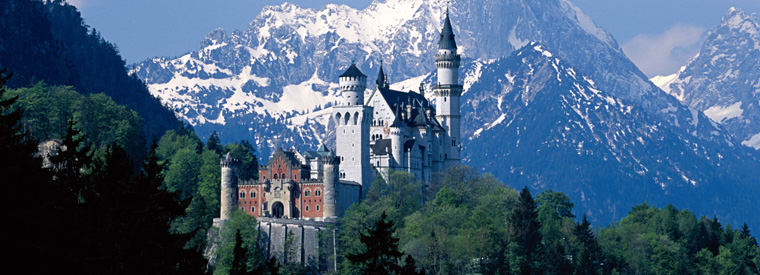
Neuschwanstein Castle (German: Schloss Neuschwanstein) is a 19th-century Romanesque Revival palace on a rugged hill above the village of Hohenschwangau near Fussen in southwest Bavaria. The palace was commissioned by Ludwig II of Bavaria as a retreat and as an homage to Richard Wagner. Contrary to common belief, Ludwig paid for the palace out of his personal fortune and extensive borrowing …
» Plassenburg Castle
Plassenburg is a castle in the city of Kulmbach in Bavaria. It is one of the most impressive castles in Germany and a symbol of the city. It was first mentioned in 1135. The Plassenberg family were ministerial of the counts of Andechs (later the dukes of Andechs-Meranien) and used as their seat the Plassenburg. The House of Guttenberg, a prominent Franconian noble family, traces its origins back to 1149 …
» Discover Regensburg
Regensburg is a city in Bavaria, Germany, located at the confluence of the Danube and Regen rivers, at the northernmost bend in the Danube. To the east lies the Bavarian Forest. Regensburg is the capital of the Bavarian administrative region Upper Palatinate. The large medieval centre of the city is a UNESCO World Heritage Site …
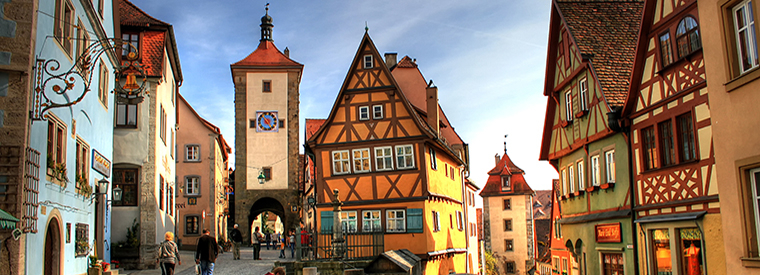
» Discover Rothenburg ob der Tauber
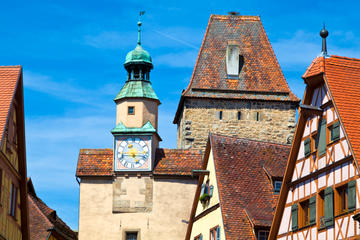
Rothenburg ob der Tauber is a town in the district of Ansbach of Mittelfranken (Middle Franconia), the Franconia region of Bavaria, Germany, well known for its well-preserved medieval old town. In the Middle Ages, it was an Imperial Free City. A significant fraction of Rothenburg is carfree …
» Discover St. Bartholomew's Church
St. Bartholomew's Churchis a Catholic pilgrimage church in Bavaria. It named for Saint Bartholomew the Apostle (Bartholomaus in German), patron of alpine farmers and dairymen. The church is located at the western shore of the Konigssee lake, on the Hirschau peninsula. It can only be reached by ship or after a long hike across the surrounding mountains …
» Discover Wurzburg
Founded in the 10th century, Wuerzburg (or Wurzburg) served as the home of powerful prince-bishops for many centuries. It is home to one of the oldest churches in Germany, built in the 8th century on top of a former pagan shrine. One of its most famous structures, Festung Marienberg, is a fortress which now surrounds the church …